Finite element scheme for the
porous medium equation
with fractional pressure


(joint work with José Carrillo, Endre Süli)
2 July 2026
SciCADE Edinburgh
Contributed talk CT11: Fractional equations
Presentation plan
- The fractional porous medium equation
- Finite Element approximation
- Discrete-in-time approximation
- Numerical experiment
The porous medium equation with fractional pressure
Porous medium equation
density $\rho = \rho(x, t)$, velocity field $\bm{v} = \bm{v}(x, t)$
\[ \frac{\partial \rho}{\partial t} + \nabla \cdot (\rho \bm{v}) = 0 \]
potential $c= c(x, t)$
\[ \bm{v} = - \nabla c \]
Idea : $ \quad - (-\Delta)^{s} c = \rho$ , $\quad 0 < s < 1$
We relate the potential and the density using the fractional Laplacian $(-\Delta)^{s}$
☞ Caffarelli, Vazquez (2011)

What is the fractional Laplacian?
Fractional Laplacian: Singular integral definition
Let $u: \mathbb{R}^{d} \rightarrow \mathbb{R}$, the fractional Laplacian of $u$ is given by \[ \begin{aligned} (-\Delta)^{s}u(x) &= \mathcal{C}(d, s) \; \textup{P.V.} \int_{\mathbb{R}^{d}} \frac{u(x) - u(y)}{|x-y|^{d + 2s}} dy \\ &= \mathcal{C}(d, s) \; \lim_{\epsilon \rightarrow 0} \int_{\mathbb{R}^{d} \setminus B_{\epsilon}} \frac{u(x) - u(y)}{|x-y|^{d + 2s}} dy \end{aligned} \]
What is the fractional Laplacian?
Spectral fractional Laplacian
Let $\Omega$ be an open, bounded, Lipschitz domain. Let $\{ \psi_{k} \}_{k \geq 1}$ the eigenfunctions of the Laplace operator with a boundary condition $\mathcal{B}(\psi) = 0$, satisfying the eigenvalue problem \[ \left \{ \begin{array}{ll} -\Delta \psi = \lambda \psi & \textrm{in } \Omega, \\ \mathcal{B}(\psi) = 0 & \textrm{on } \partial \Omega. \end{array} \right. \] The spectral fractional Laplacian with boundary condition $\mathcal{B}$ can then be defined by \[ (-\Delta_{\mathcal{B}})^{s} u := \sum_{k=1}^{\infty} \lambda_{k}^{s} u_{k} \psi_{k} \quad \textrm{with } u_{k} = \int_{\Omega} u \psi_{k} \,\text{d}x. \]
Spectral fractional Sobolev space
Let $\Omega$ be an open, bounded, Lipschitz domain. Let $\{ \psi_{k} \}_{k \geq 1}$ the eigenfunctions of the Laplace operator with a boundary condition $\mathcal{B}(\psi) = 0$, satisfying the eigenvalue problem \[ \mathbb{H}^s_{\mathcal{B}}(\Omega) := \Bigg \{ u(\cdot) = \sum_{k=1}^{\infty} u_{k} \psi_{k}(\cdot) \in L^{2}(\Omega): \|u\|^{2}_{\mathbb{H}^s_{\mathcal{B}}(\Omega)} := \sum_{k=1}^{\infty} \lambda_{k}^{s} u_{k}^{2} < \infty \Bigg \} \] \[ \textrm{with } u_{k} := \int_{\Omega} u(x) \psi_{k}(x) \textrm{d}x. \]
What does this give us more in terms of applications?
- Filtration of a fluid through a porous stratum: different pores, tubes and water filaments can make the phenomenon difficult to study $\Rightarrow$ standard models fail in modelling
- Fractional Laplacian models non-local interactions and effects
- More realistic in certain contexts (hydrological setting), where the fluid in the porous medium can contribute to the flux at any point with long jumps
Porous medium equation with a fractional potential
\[ \left \{ \begin{aligned} &\frac{\partial \rho}{\partial t} = \Delta \rho - \nabla \cdot (\rho \nabla c) & \textrm{in } \Omega \times (0, \infty) , \\ & - (-\Delta)^{s} c = \rho^{\ast} = \rho - \int_{\Omega} \rho \, \text{d}x & \textrm{in } \Omega \times (0, \infty), \\ &\partial_{n} \rho = 0, \quad \partial_{n} c = 0 & \textrm{on }\partial \Omega \times (0, \infty). \end{aligned} \right. \]
For us $\Omega$ will be a bounded open polygonal domain in $\mathbb{R}^{2}$ or a bounded open Lipschitz polyhedral domain in $\mathbb{R}^{3}$.
Weak formulation
Let $V = H^{1}(\Omega)$, find $\rho \in L^{2}(0, T; V)$ with $\frac{\partial \rho}{\partial t} \in L^{\infty}(0, T; V')$ such that
\[ \Big\langle \frac{\partial \rho}{\partial t}, \phi \Big\rangle = - \int_{\Omega} \nabla \rho \cdot \nabla \phi + \int_{\Omega} \rho \nabla c \cdot \nabla \phi \quad \text{for all } \phi \in V, \text{ and a. e. } t \in (0, T], \]
where
\[ -(-\Delta_{\mathrm{N}})^{s} c = \rho^{\ast} \textrm{ in } \Omega, \]
subject to the initial condition $\rho(x, 0) = \rho_{0}(x)$, where $\rho_{0} \in L^{\infty}(\Omega)$ and
$\rho_{0}(x) \geq 0$ for a.e. $x \in \Omega$.
Important property : decay in time of the $L^{\infty}$ norm in space
Corollary
Let $\rho$ be be a nonnegative strong solution of the porous medium equation with fractional pressure. The following result holds: \[ \|\rho(t)\|_{L^{\infty}(\Omega)} \leq C \|\rho_{0}\|_{L^{\infty}(\Omega)}. \]
☞ Caffarelli, Soria, Vazquez (2012) proof on $\mathbb{R}^d$ with the integral representation of $(-\Delta)^s$ and no parabolic regularization
☞ Chen, Holzinger, Jüngel, Zamponi (2022) proof on $\mathbb{R}^d$ with the integral representation of $(-\Delta)^s$ with parabolic regularization
Important property : decay in time for the free energy functional
Let us define \[ G(s) := s(\log s - 1) + 1 \quad \text{for } s > 0 \quad \text{and} \quad G(0):= 1\] and the free energy functional \[ E(\rho) := \int_{\Omega} G(\rho) \, \text{d} x - \frac{1}{2} \int_{\Omega} c \rho \, \text{d}x. \]
Lemma
Let $\rho$ be a nonnegative strong solution of the fractional porous medium equation. Then the following free energy identity holds for all $t\geq 0$ \[ \frac{d}{dt} E(\rho) = - \int_{\Omega} \rho |\nabla (\log \rho - c)|^{2} \, \text{d}x \leq 0 . \]
Regularized weak formualtion
Ingredients :
- cut-off function $\beta_{\delta}^{L}(\cdot)$ with parameters $0< \delta < 1$, $L>1$ \[ \beta_{\delta}^{L}(s) = \left \{ \begin{array}{ll} \delta & s \leq \delta, \\ s & \delta < s < L, \\ L & s \geq L. \end{array} \right. \]
Find $\rho_{\delta, L} \in L^{2}(0, T; V)$ with $\frac{\partial \rho}{\partial t} \in L^{\infty}(0, T; V')$ such that \[ \Big\langle \frac{\partial \rho_{\delta, L}}{\partial t}, \phi \Big\rangle = - \int_{\Omega} \nabla \rho_{\delta, L} \cdot \nabla \phi + \int_{\Omega} \beta_{\delta}^{L}(\rho_{\delta, L}) \nabla c_{\delta, L} \cdot \nabla \phi \quad \text{for all } \phi \in V \quad \text{and a.e. } t \in (0, T], \] where \[ -(-\Delta_{\mathrm{N}})^{s} c = \rho_{\delta, L}^{\ast} \textrm{ in } \Omega, \] subject to the initial condition $\rho_{\delta, L}(x, 0) = \rho_{0}(x)$.
Finite Element approximation
Fractional Porous Medium equation
\[ \left \{ \begin{aligned} &\frac{\partial \rho}{\partial t} = \Delta \rho - \nabla \cdot (\rho \nabla c) & \textrm{in } \Omega \times (0, \infty) , \\ & - (-\Delta)^{s} c = \rho^{\ast} & \textrm{in } \Omega \times (0, \infty), \\ &\partial_{n} \rho = 0, \quad \partial_{n} c = 0 & \textrm{on }\partial \Omega \times (0, \infty). \end{aligned} \right. \]
We want to design a finite element scheme to solve the equation
Finite Element scheme
Ingredients :
- $\mathcal{T}_{h}= \{ K_{n} \}_{n=1}^{M_{h}}$ a quasi-uniform, shape regular and weakly acute triangulation of the domain, $\overline{\Omega} = \cup_{n=1}^{M_{h}} K_{n}$,
- the space of continuous piecewise linear functions
$V_{h} = \{ v_{h} \in C(\overline{\Omega}) \textrm{ such that } v_{h}\big|_{K} \in \mathbb{P}^{1} \textrm{ for all } K \in \mathcal{T}_{h} \}$, - a finite element approximation of the fractional Laplacian
\[ (-\Delta_{h})^{s} u_{h} := \sum_{k=1}^{N_{h}} (\lambda_{k}^{h})^{s} u_{k}^{h} \varphi_{k}^{h} \quad \textrm{with } u_{k}^{h} := \int_{\Omega} u_{h} \varphi_{k}^{h} \,\text{d}x, \] where $\varphi_{k}^{h}$ are the eigenfunctions of the bilinear form $a(\phi, \psi) = \int_{\Omega} \nabla \phi \cdot \nabla \psi \, \text{d}x$ in $V_{h} \cap L^{2}_{\ast}(\Omega)$.
Finite Element scheme
- discrete counterpart of $\beta_{\delta}^{L}(\cdot)$, a diagonal matrix $\Theta_{\delta}^{L}(\phi_{h}) \in \mathbb{R}^{d \times d}$ defined as follows:
for $x \in \Omega$ let $K$ be the element with $x \in K$ and let $\{ P_{i} \}_{i = 0}^{d}$ be the vertices of the simplex; then, for $j = 1, \dots, d$, \[ \widetilde{\Theta}_{\delta}^{L}(\phi_{h})_{jj}(x) = \left \{ \begin{aligned}& \frac{\phi_{h}(P_{j}) - \phi_{h}(P_{0})}{(G_{\delta}^{L})'(\phi_{h}(P_{j})) - (G_{\delta}^{L})'(\phi_{h}(P_{0}))} & \textrm{if } \phi_{h}(P_{j}) \neq \phi_{h}(P_{0}), \\ &\frac{1}{(G_{\delta}^{L})''(\phi_{h}(P_{j}))} = \beta_{\delta}^{L}(\phi_{h}(P_{j})) & \textrm{if } \phi_{h}(P_{j}) = \phi_{0}(P_{j}); \end{aligned} \right. \] let $\widehat{K}$ be the reference simplex and $y \mapsto P_{0} + B_{K} y$ the affine mapping which maps $\widehat{K}$ to $K$, define \[ \Theta_{\delta}^{L}(\phi_{h})(x) = (B_{K}^{\mathrm{T}})^{-1} \widetilde{\Theta}_{\delta}^{L}(\phi_{h})(x) B_{K}^{\mathrm{T}}. \] ☞ Grün, Rumpf (2000) ☞ Barrett, Garcke, Nürnberg (2003)
Finite Element scheme
\[ \]
Finite Element scheme
Theorem
There exists a subsequence of $\{ \rho_{h, \delta, L}^{n} \}_{\delta, h >0}$ and a nonnegative function $\rho_{L}^{n} \in V$ such that, as $\delta, h \to 0_{+}$ \[ \begin{aligned} \rho_{h, \delta, L}^{n} &\to \rho_{L}^{n} &\text{strongly in} \quad &L^{2}(\Omega), \\ \nabla \rho_{h, \delta, L} &\to \nabla \rho_{L}^{n} & \text{weakly in} \quad &L^{2}(\Omega; \mathbb{R}^{d}), \\ \Theta_{\delta}^{L}(\rho_{h, \delta, L}^{n}) &\to \beta^{L}(\rho^{n}_{L}) I & \text{strongly in} \quad &L^{2}(\Omega; \mathbb{R}^{d \times d}), \\ c_{h, \delta, L}^{n} &\to c_{L}^{n} & \text{strongly in} \quad &L^{2}_{\ast}(\Omega), \\ \nabla c_{h, \delta, L}^{n} &\to \nabla c_{L}^{n} & \text{weakly in} \quad &L^{2}_{\ast}(\Omega; \mathbb{R}^{d}). \end{aligned} \] Moreover $\{ \rho^{n}_{L} \}_{n=1, \dots, N}$ solves a discrete-in-time scheme and given $\rho_{L}^{0}$ such that $\frac{1}{|\Omega|} \int_{\Omega} \rho^{0} \, \text{d}x = 1$, one has $\frac{1}{|\Omega|} \int_{\Omega} \rho^{n}_{L} \, \text{d}x = 1$ for all $n=1, \dots, N$ .
Finite Element scheme
Moreover $\{ \rho^{n}_{L} \}_{n=1, \dots, N}$ solves the discrete-in-time scheme:
For $n = 1, \dots, N$, given $\rho_{L}^{n-1} \in V$ find $\rho_{L}^{n} \in V$ such that \[ \int_{\Omega} \frac{\rho_{L}^{n} - \rho_{L}^{n-1}}{\Delta t} \phi \,\text{d}x = - \int_{\Omega} \nabla \rho_{L}^{n} \cdot \nabla \phi + \int_{\Omega} \beta^{L}(\rho_{L}^{n}) \nabla c_{L}^{n} \cdot \nabla \phi \quad \textrm{for all } \phi \in V, \] where \[ - (-\Delta_{\mathrm{N}})^{s} c_{L}^{n} = (\rho_{L}^{n})^{\ast}, \quad \partial_{n} c_{L}^{n} = 0 \textrm{ on } \partial \Omega \] subject to the initial condition $\rho_{L}^{0} = \rho^{0}$.
Discrete-in-time approximation
Discrete-in-time scheme
Ingredients :
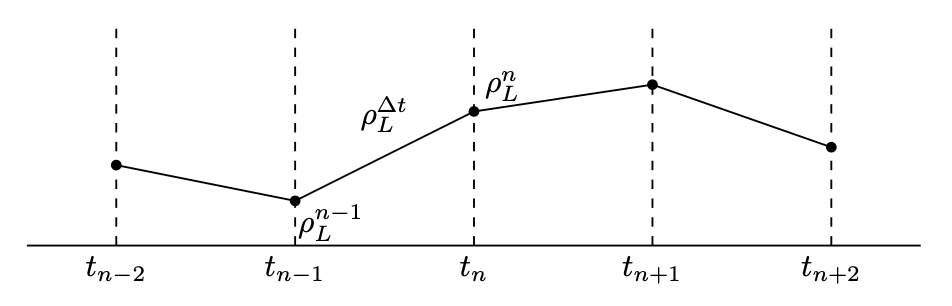
- linear interpolation in time \[ \rho_{L}^{\Delta t}(\cdot, t) := \frac{t - t_{n-1}}{\Delta t} \rho_{L}^{n}(\cdot) + \frac{t_{n} - t}{\Delta t } \rho_{L}^{n-1}(\cdot), \quad t \in [t_{n-1}, t_{n}], \quad n = 1, \dots, N \] \[ \rho_{L}^{\Delta t, +}(\cdot, t) := \rho_{L}^{n}(\cdot), \quad \rho_{L}^{\Delta t, -}(\cdot, t) := \rho_{L}^{n-1}(\cdot), \quad t \in (t_{n-1}, t_{n}), \quad n =1, \dots, N. \]
Discrete-in-time scheme
- uniform bound on $L^{\infty}(\Omega)$ norm of the solution $\rho_{L}^{\Delta t}$, to get rid of the cut-off parameter $L$
Corollary
Let $\rho_{L}^{\Delta t (,\pm)}$ defined as before. The following bound holds: \[ \sup_{t \in [0,T]} \|\rho_{L}^{\Delta t (,\pm)}(t)\|_{L^{\infty}(\Omega)} \leq C \|\rho_{0}\|_{L^{\infty}(\Omega)}. \]
Discrete-in-time scheme
- Compactness argument
Dubinskiǐ's compactness theorem
Suppose that $\mathcal{A}_{0}$ and $\mathcal{A}_{1}$ are Banach spaces, $\mathcal{A}_{0} \hookrightarrow \mathcal{A}_{1}$ (i.e., $\mathcal{A}_{0}$ is continuously embedded in $\mathcal{A}_{1}$), and $\mathcal{C}$ is a seminormed set contained in $\mathcal{A}_{0}$ such that $\mathcal{C}$ is compactly embedded in $\mathcal{A}_{0}$. Consider the set \[ \mathcal{Y} \coloneqq \Bigg \{ \varphi: [0, T] \to \mathcal{C}: [\varphi]_{L^{p}(0, T; \mathcal{C})} + \bigg\| \frac{\mathrm{d} \varphi}{\text{d}t}\bigg\|_{L^{p_{1}}(0, T; \mathcal{A}_{1})} < \infty \Bigg \}, \] where $1\leq p \leq \infty$, $1\leq p_{1} \leq \infty$, $\| \cdot \|_{\mathcal{A}_{1}}$ is the norm of $\mathcal{A}_{1}$ and $\frac{\text{d}\varphi}{\text{d}t}$ is understood in the sense of $\mathcal{A}_{1}$-valued distributions on the open interval $(0, T)$. Then $\mathcal{Y}$, with \[ [\varphi]_{\mathcal{Y}} \coloneqq [\varphi]_{L^{p}(0, T; \mathcal{C})} + \bigg\| \frac{\mathrm{d} \varphi}{\text{d}t} \bigg\|_{L^{p_{1}}(0, T; \mathcal{A}_{1})}, \] is a seminormed set in $L^{p}(0, T; \mathcal{A}_{0}) \cap W^{1, p_{1}}(0, T; \mathcal{A}_{1})$, and $\mathcal{Y}$ is compactly embedded in $L^{p}(0, T; \mathcal{A}_{0})$ if either $1 \leq p \leq \infty$ and $1< p_{1} < \infty$, or if $1 \leq p < \infty$ and $p_{1}=1$.
Discrete-in-time scheme
In our setting \[ \mathcal{A}_{0} = L^{1}(\Omega), \textrm{ with the usual Lebesgue norm } \|\varphi\|_{\mathcal{A}_{0}} \coloneqq \int_{\Omega} |\varphi| \text{d}x \] and \[ \mathcal{C} = \Bigg \{ \phi \in \mathcal{A}_{0}: \varphi \geq 0 \textrm{ with } \int_{\Omega}\big| \nabla \sqrt{\varphi} \big|^{2} \text{d}x < \infty \Bigg \};\] and, for $\varphi \in \mathcal{C}$, we define \[ [\varphi]_{\mathcal{C}} \coloneqq \|\varphi\|_{\mathcal{A}_{0}} + \int_{\Omega}\big| \nabla \sqrt{\varphi} \big|^{2} \text{d}x,\] \[ \mathcal{A}_{1} = H^{-\beta}(\Omega) \coloneqq [H^{\beta}(\Omega)]'\quad \beta = d + 1, \] equipped with the dual norm $\|\varphi\|_{\mathcal{A}_{1}} \coloneqq \|\varphi\|_{H^{-\beta}(\Omega)}$.
Discrete-in-time scheme
Discrete-in-time scheme
Theorem
There exists a subsequence $\{ \rho^{\Delta t(,\pm)} \}_{\Delta t>0}$ and a function $\widehat{\rho}$ such that \[ \widehat{\rho} \in L^{\infty}(0, T, L^{\infty}(\Omega)) \cap H^{1}(0, T, H^{-\beta}(\Omega)), \quad \beta = d+1, \] with $\widehat{\rho} \geq 0$ almost everywhere on $\Omega \times (0, T)$ and $\frac{1}{|\Omega|} \int_{\Omega} \widehat{\rho}(x, t) \, \text{d}x = 1$ for a.e. $t \in [0, T]$, and a function $\widehat{c}(\cdot, t) \in \mathbb{H}^{s}(\Omega) \cap H^{1}_{\ast}(\Omega)$, defined as $-(-\Delta_{\mathrm{N}})^{s} \widehat{c} = \widehat{\rho}^{\ast}$, such that, for all $p \in [1, \infty)$, as $\Delta t \to 0$, \[ \begin{aligned} \rho^{\Delta t(,\pm)} & \to \widehat{\rho} &\text{strongly in} \quad & L^{p}(0,T;L^{1}(\Omega)), \\ \nabla \sqrt{\rho^{\Delta t(,\pm)}} & \to \nabla \sqrt{\widehat{\rho}} &\text{weakly in} \quad & L^{2}(0,T;L^{2}(\Omega; \mathbb{R}^{d})), \\ \frac{\partial \rho^{\Delta t}}{\partial t} & \to \frac{\partial \widehat{\rho}}{\partial t} &\text{weakly in} \quad & L^{2}(0,T; H^{-\beta}(\Omega)), \\ \rho^{\Delta t(,\pm)} & \to \widehat{\rho} &\text{weakly-$*$ in} \quad & L^{\infty}(0,T;L^{\infty}(\Omega)), \\ \rho^{\Delta t(,\pm)} & \to \widehat{\rho} &\text{strongly in} \quad & L^{p}(0,T;L^{p}(\Omega)), \end{aligned} \]
Discrete-in-time scheme
\[ \begin{aligned} c^{\Delta t(,\pm)} & \to \widehat{c} & \text{strongly in} \quad & L^{p}(0, T; \mathbb{H}^{s}(\Omega)), \\ \nabla c^{\Delta t, +} & \to \nabla \widehat{c} & \text{weakly in} \quad & L^{2}(0, T; L^{2}(\Omega; \mathbb{R}^{d})). \end{aligned} \] Moreover the function $\widehat{\rho}$ is a global weak solution to the problem
\[ \begin{gathered} -\int_{0}^{T} \int_{\Omega} \widehat{\rho} \frac{\partial \phi}{\partial t} \, \text{d}x \, \text{d}t + \int_{0}^{T} \int_{\Omega} \nabla \widehat{\rho} \cdot \nabla \phi \, \text{d}x \, \text{d}t + \int_{0}^{T} \int_{\Omega} \widehat{\rho} \, \nabla \widehat{c} \cdot \nabla \phi \, \text{d}x \, \text{d}t= \int_{\Omega} \rho_{0} \;\phi|_{t=0} \, \text{d}x \\ \text{for all } \phi \in W^{1,1}(0, T; H^{\beta}(\Omega)) \text{ such that } \phi(., T) = 0. \end{gathered} \]
In addition, the function $\widehat{\rho}$ is weak-$*$ continuous as a mapping from $[0,T]$ to $L^{\infty}(\Omega)$ and it is weakly continuous as a mapping from $[0, T]$ to $L^{1}(\Omega)$. The energy functional $E(\cdot)$ satisfies the inequality \[ E(\widehat{\rho}(t)) + \int_{0}^{t} \int_{\Omega} \bigg| 2 \nabla \sqrt{\widehat{\rho}} - \sqrt{\widehat{\rho}} \nabla \widehat{c} \bigg|^{2} \text{d}x \text{d}\tau \leq E(\rho_{0}), \] for a.e. $t \in [0, T]$.
Numerical experiment
\[\text{Recall} \quad (-\Delta_{h})^{s} u_{h} := \sum_{k=1}^{N_{h}} (\lambda_{k}^{h})^{s} u_{k}^{h} \varphi_{k}^{h} \]
Problem : solve efficiently the fractional Poisson equation \[ (-\Delta)^{s} u = f \quad \text{in } \Omega. \]
For the standard Poisson equation, using finite elements, we need to solve a linear system,
\[ -\Delta u = f \quad \leadsto \quad SU = F, \]
where $S$ is the stiffness matrix.
For the fractional Poisson equation we should compute the $s$-th power of a matrix
\[ (-\Delta)^{s} u = f \quad \leadsto \quad A^{s}U = F. \]
It turns out that $A = M^{-1}S$, where $M$ is the mass matrix.
Compute the $s$-th power using a rational approximation $r(x) \sim x^{-s}$, where \[ r \in \mathcal{R}_{n,n} = \bigg \{ \frac{p}{q}: p \in \mathbb{R}_{m}[x], q \in \mathbb{R}_{n}[x]\bigg \}, \] \[ r (x) = R_{0} + \frac{R_{1}}{ x- t_{1}} + \dots + \frac{R_{n}}{x - t_{n}}. \]
Work with matrix \[ A^{-s} \sim r(A) = R_{0} I + R_{1} (A - t_{1}I)^{-1} + \dots + R_{n} (A - t_{n}I)^{-1}. \]
$\star$ To compute the rational approximation $r$ we use the minimax algorithm
☞ Filip-Nakatsukasa-Trefethen-Bernhard (2018)
Computational benefits: no need to know all the (discrete) spectrum (only min and max eigenvalues ), no storage of dense matrices, at each time step just solve $n$ sparse linear systems, available error estimates
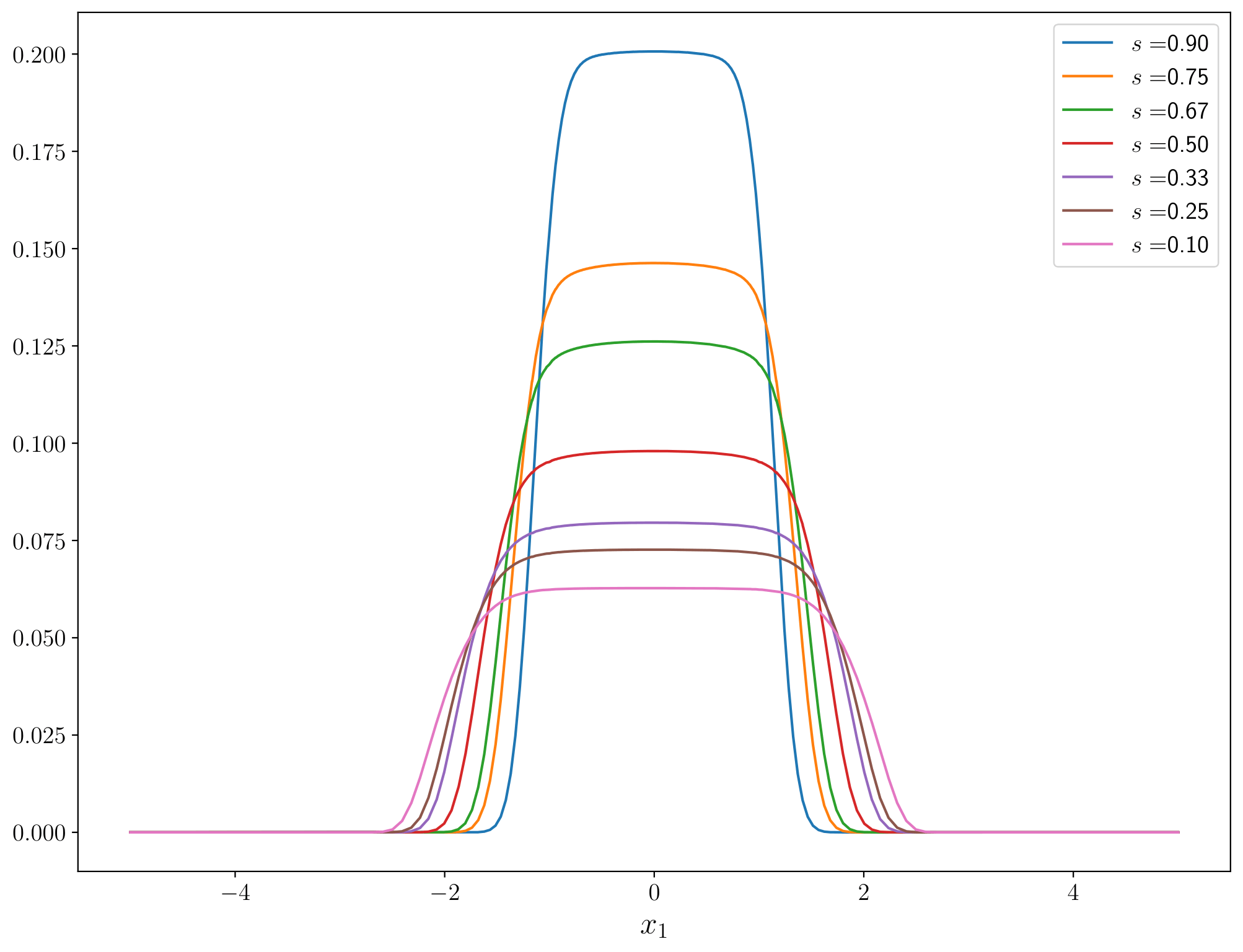
We can get simulations for the fractional porous medium equation for different fractional orders on a large variety of domains, in an efficient and fast way. We can compare different self similar profiles to see the effect of having fractional Laplacian in the potential
central section of 2D simulations
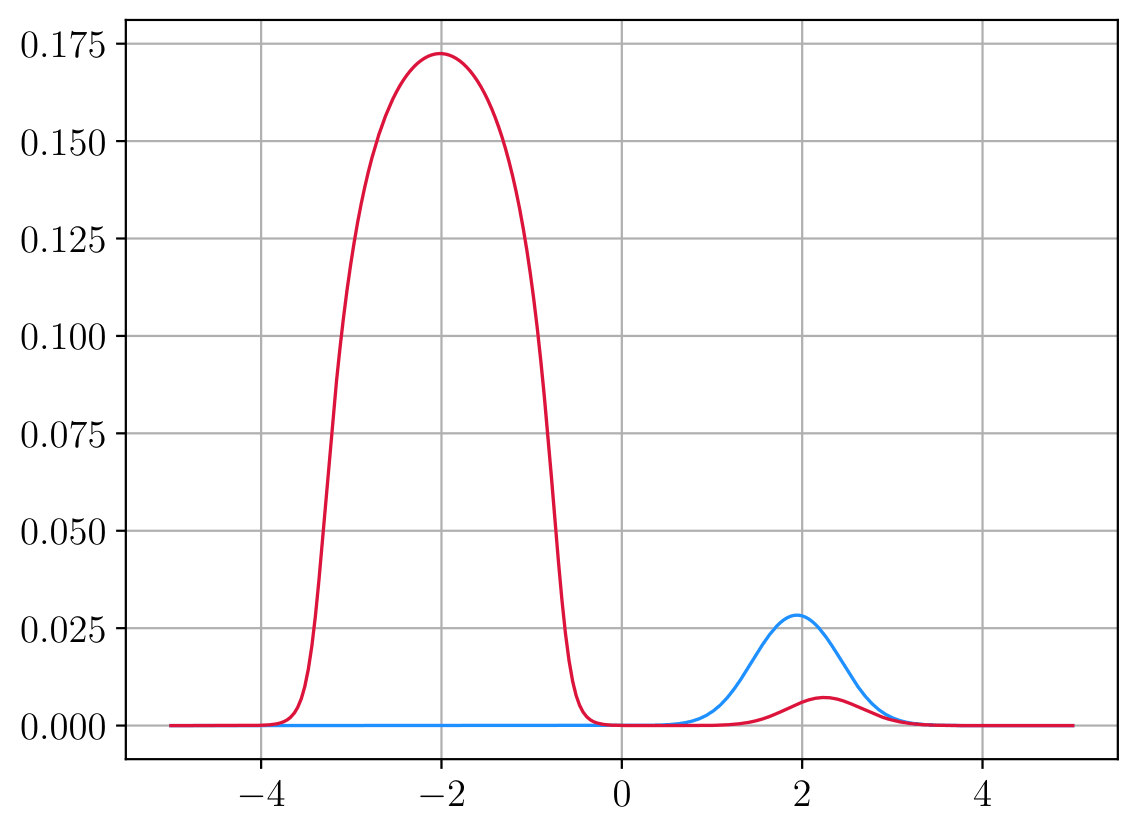
Property: the comparison principle does not hold.
☞ Caffarelli, Vazquez (2011) proof on $\mathbb{R}^d$ with the integral representation of $(-\Delta)^s$ and no parabolic regularization
☞ del Teso, Jakobsen (2025) numerical experiment in 1D, finite difference scheme
Consider different initial data $u_{1}$ and $u_2$ on $\Omega = (-5,5)^{2}$, $s=0.75$
initially ordered $u_1 \leq u_2$: for some $c>0$
\[ u_1(x) = \exp(-|x-2|^2/c), \qquad u_2(x) = \exp(-|x-2|^2/c) + 2 \exp(-|x+2|^2/c). \]
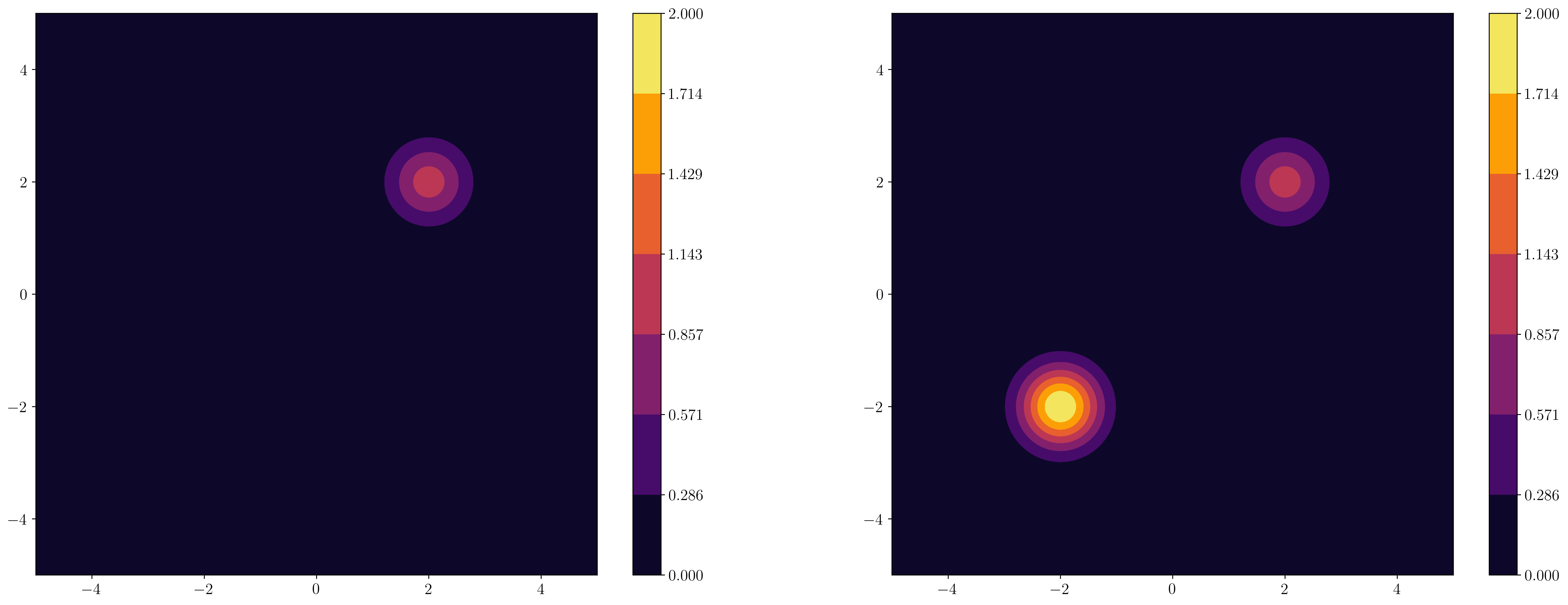
Property: the comparison principle does not hold.
Consider different initial data $u_{1}$ and $u_2$ on $\Omega = (-5,5)^{2}$, $s=0.75$
initially ordered $u_1 \leq u_2$: for some $c>0$
\[ u_1(x) = \exp(-|x-2|^2/c), \qquad u_2(x) = \exp(-|x-2|^2/c) + 2 \exp(-|x+2|^2/c). \]
diagonal section $x_1=x_2$
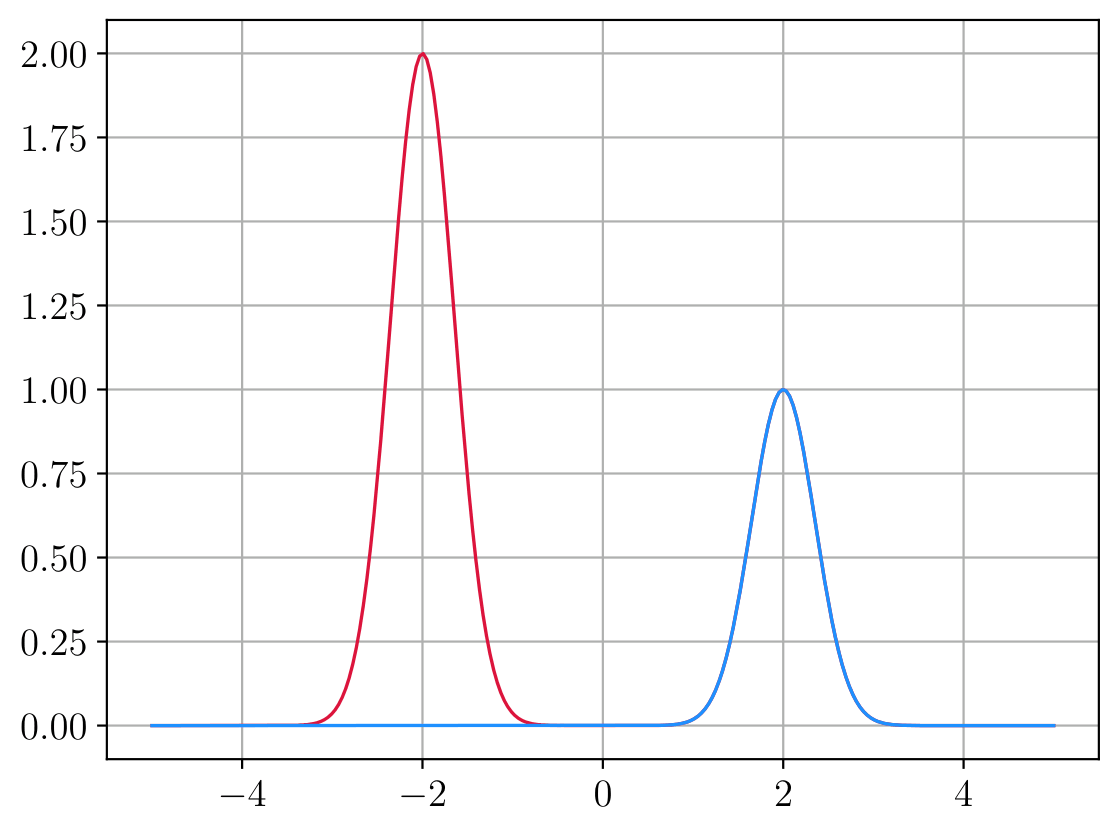
central section $x_2=0$
Property: the comparison principle does not hold.
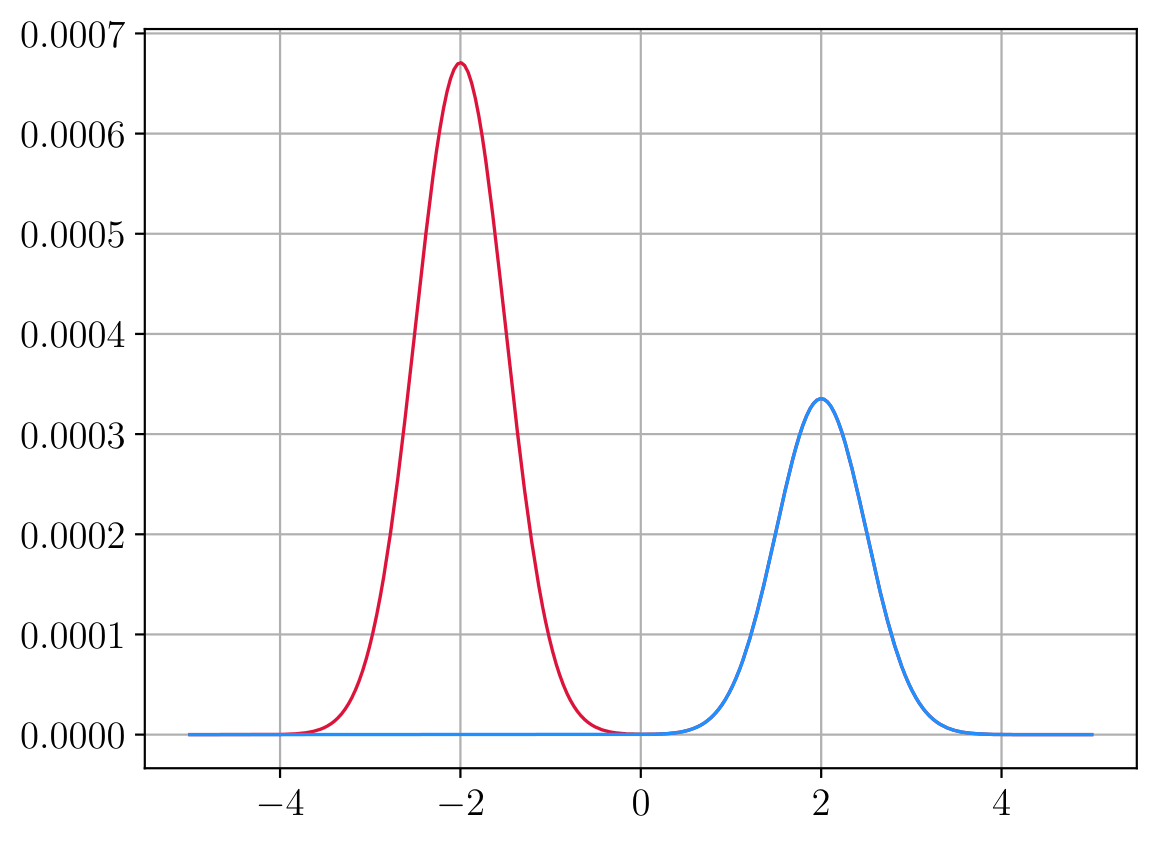
Consider different initial data $u_{1}$ and $u_2$ on $\Omega = (-5,5)^{2}$, $s=0.75$
initially ordered $u_1 \leq u_2$: for some $c>0$
\[ u_1(x) = \exp(-|x-2|^2/c), \qquad u_2(x) = \exp(-|x-2|^2/c) + 2 \exp(-|x+2|^2/c). \]
Property: the comparison principle does not hold.
Consider different initial data $u_{1}$ and $u_2$ on $\Omega = (-5,5)^{2}$, $s=0.75$
initially ordered $u_1 \leq u_2$: for some $c>0$
\[ u_1(x) = \exp(-|x-2|^2/c), \qquad u_2(x) = \exp(-|x-2|^2/c) + 2 \exp(-|x+2|^2/c). \]
diagonal section $x_1=x_2$
Property: the comparison principle does not hold.
Consider different initial data $u_{1}$ and $u_2$ on $\Omega = (-5,5)^{2}$, $s=0.75$
initially ordered $u_1 \leq u_2$: for some $c>0$
\[ u_1(x) = \exp(-|x-2|^2/c), \qquad u_2(x) = \exp(-|x-2|^2/c) + 2 \exp(-|x+2|^2/c). \]
central section $x_2=0$
Property: the comparison principle does not hold.
Consider different initial data $u_{1}$ and $u_2$ on $\Omega = (-5,5)^{2}$, $s=0.75$
initially ordered $u_1 \leq u_2$: for some $c>0$
\[ u_1(x) = \exp(-|x-2|^2/c), \qquad u_2(x) = \exp(-|x-2|^2/c) + 2 \exp(-|x+2|^2/c). \]
diagonal section $x_1=x_2$
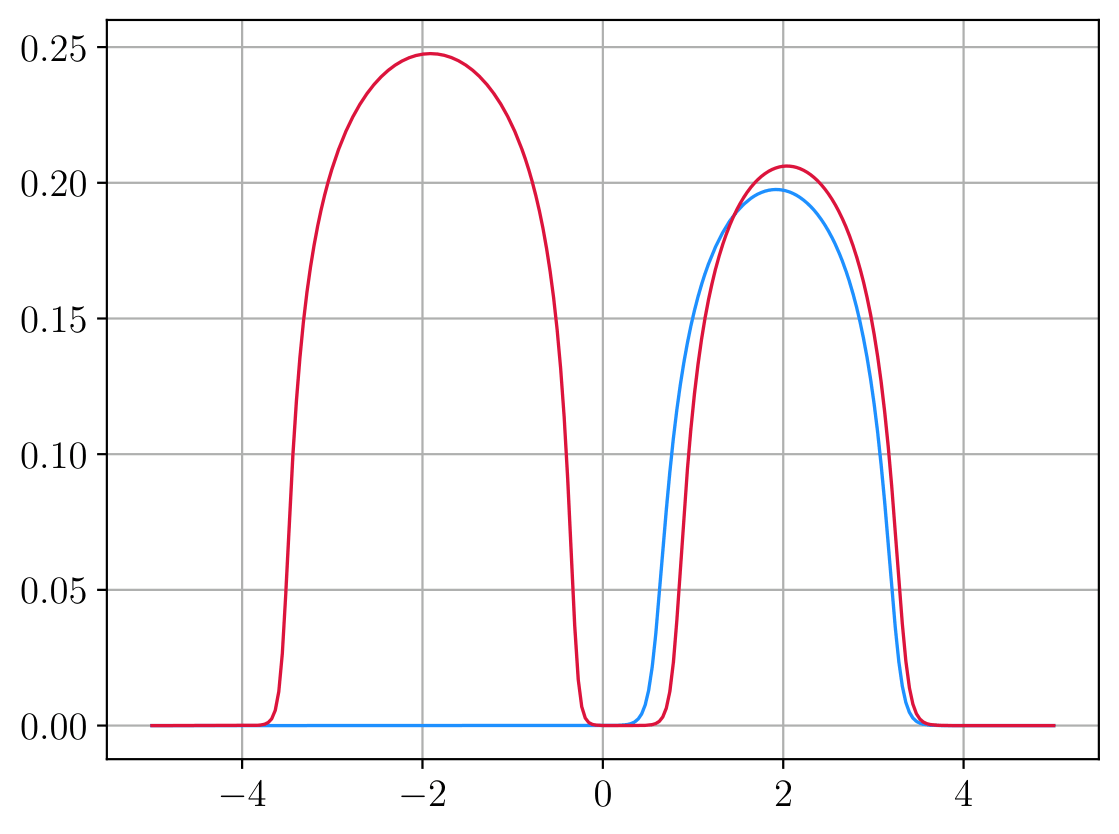
central section $x_2=0$
Thank you for the attention
If you want to know more...